Warm Home Discount and Winter Fuel Payment
How to spot a scam
Over the winter months, there are a number of financial support schemes for eligible households, but it's important to be aware of potential scams that we often see at this time of year.

Every winter, millions of residents across the UK in receipt of means-tested benefits will receive a one-off payment of £150 from their electricity supplier, to help them manage the higher energy costs during the coldest time of the year. This Warm Home Discount (sometimes known as the WHD) is usually paid out between October and March of each winter.
The Government also supports households with residents who are in receipt of Pension Credit or have a total household income of under £35,000 a year through the annual Winter Fuel Payment (sometimes known as the WFP).
These schemes offer a level of financial support to those who are eligible for it when their bills are at their highest, unfortunately scammers are also aware, and take advantage of people’s eagerness to receive their payment.
Warm Home Discount
Those eligible should receive an official Government letter through the post. You are eligible for Warm Home Discount if both conditions apply:
- You, or another eligible adult in your home were named on the electricity bill or account on or before 23rd August 2026 (the “Qualifying date”).
AND
- The person named on the electricity account was in receipt of Universal Credit, Housing Benefit, Pension Credit or Income Related Employment and Support Allowance (IR-ESA) on the same Qualifying date.
There are 2 versions of the official Government letter:
- If the eligibility has been confirmed by the Government, and no further information is needed - you will get a letter confirming that you will receive the payment. No further action will be needed from the household. This will be paid automatically and should be the case for the large proportion of eligible households.
- If you have been flagged as potentially being eligible, you will get a letter asking for contact to the Warm Home Discount helpline for them to request further information from you.
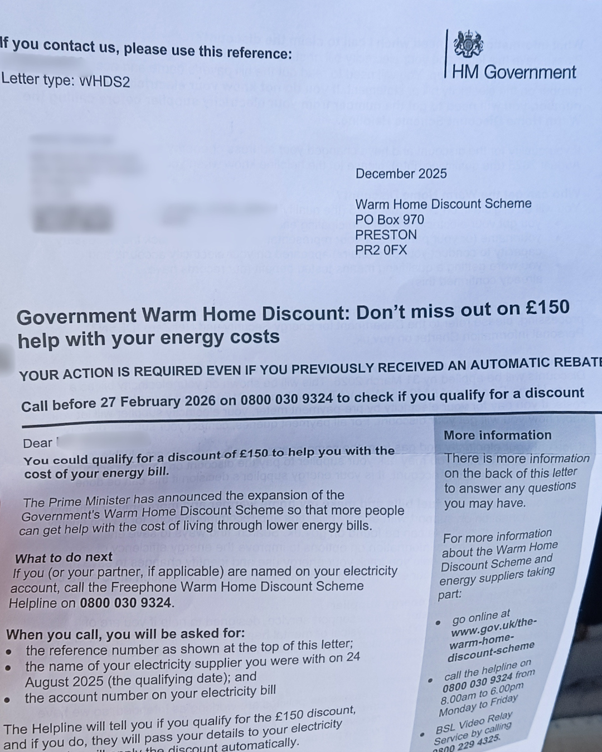
If you believe you are eligible, you should be in receipt of one of the two letter types between October 2026 and early January 2027. This letter will have a reference number unique to your household. If you have not received a letter by the end of January 2027, it’s best to ring the Warm Home Discount helpline to follow up on this - 0800 030 9322.
The Warm Home Discount has been automatically assigned to eligible households since 2022. Since then, no one has needed to apply to get the payment.
If you receive communication asking you to fill out an application form, this is a scam to gather your personal information and/or bank details.
The Government will only ever send out official letters in the post about Warm Home Discount. Any text, email or phone call about the Warm Home Discount claiming to be from the Government or your energy supplier IS A SCAM.
If you have received one of the official Government letters and have responded to any requests for further information, you can expect to receive your £150 payment between October 2026 and March 2027. How this will be paid to you varies on how you currently pay for your energy:
- Those paying by Direct Debit or making manual payments on receipt of the bill. The £150 will automatically land into your account balance and you should see it on your billing.
- Pay-as-you-go or Prepayment meter customers (who top up using a key or card). You will be sent top-up vouchers, likely through a text, email or letter through the post – some suppliers may opt for paying it through a cheque. The vouchers will come directly from your electricity supplier. If you’re not sure if the vouchers you have been sent are genuine, find your suppliers contact details independently (not through the vouchers themselves) and contact them to check if they are real.
- Smart Pay-as-you-go or Prepayment meter customers (where you can top up using the supplier’s app or website). The £150 credit will appear automatically onto your electricity balance between October and March. You don’t have to do anything, and you may notice it appear at any time in this period.
Winter Fuel Payment
To be eligible for the Winter Fuel Payment in England, someone in your household must have been born on or before 27th June 1960. This is a one-off payment of between £100-£300 dependent on household circumstances. It is usually automatic, and there are very few people who need to manually apply for it. You can read the full eligibility criteria for this scheme on this link.
Letters about Winter Fuel Payment usually go out in the post around November-December each winter, and you should contact the Winter Fuel Payment Centre if you believe you are eligible but have not yet received a letter by the end of January. Their number is 0800 731 0160.
If you are eligible, the Government typically sends you the payment via the bank or building society account that your State Pension or other benefits is paid into.
What might a scam look like?
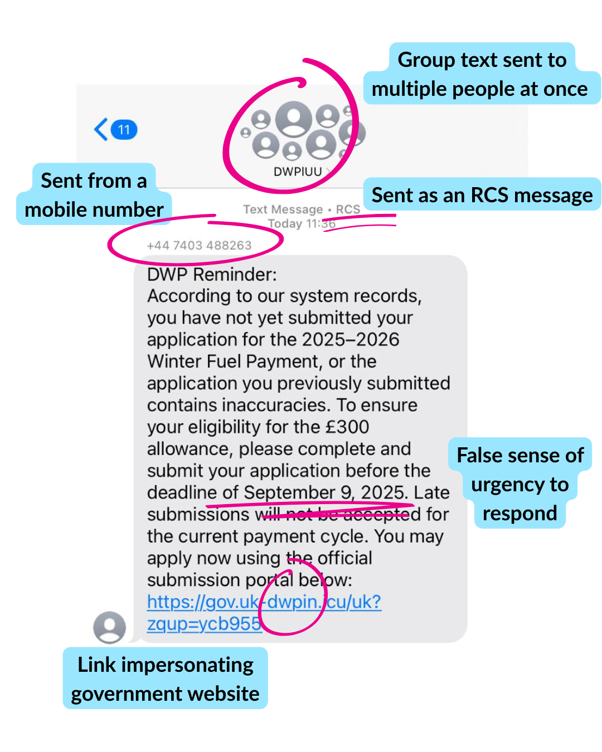
Text, email and phone scams
The Government, or your energy supplier, will NEVER ask you to respond to a text, email or call regarding payment of your Warm Home Discount or Winter Fuel Payment.
They will NEVER require you to click on any weblinks and provide personal information or ask you to make a small “deposit” or activation payment. They will not request you to submit bank details so that they can make a payment. If you receive one of these, always contact your energy supplier independently via contact methods you have searched for yourself. This can be found through your supplier’s website or on a recent bill. They can confirm for you if this was a real communication or if it was likely to be a scam.
These scams tend to use language that encourages immediate action to avoid missing out, you can also look out for poorly written text, typing errors or spelling mistakes, or dodgy looking links. All of these are red flags, and you should ignore these communications. They are sent out to thousands of people at once. If even one person falls for it , the scammers can either obtain valuable private information or fraudulently access bank accounts.
Letter scams
The Government letter will have a code on it that is unique to your household. Scammers may try to replicate these letters – again, if in doubt about whether your letter is genuine, call the main Warm Home Discount helpline which is 0800 030 9322. The real Warm Home Discount telephone helpline will never send you any links via text or email, that need to be clicked onto to submit bank details for payment.
Other scams around energy support
The Government announced in the 2026 Budget on October 28th that residents in Council Tax band properties A-D will receive a £100 “Household Energy Payment” this winter. This is a brand-new scheme and more about how it will work and be paid can be read here. Be aware that scammers may use this new support scheme as a way to trick people into sharing personal information or bank account details.
Although the schemes listed below were all real, they have now come to an end. The scammers may still use similar language about refunds, grants or rebated, to encourage you to believe their legitimacy:
Household Support Fund (HSF). This was a scheme from the Government which was run differently by each Local Authority (LA). There were several rounds between October 2021 and March 2026. This has been replaced by the Crisis and Resilience Fund in Summer 2026.
Energy Bills Support Scheme (EBSS). This was money that was paid to energy accounts (£66/£67 a month) for 6 months during the 2022 to 2023 winter period.
Support for energy bills Council Tax rebate. In 2022, the Government offered eligible households a one-off £150 Council Tax rebate to help with the cost of living.
What to do if you think you've responded to a scam
If you have clicked a link you now suspect may have been a scam and gave payment/personal information, follow the steps below.
Stop, breath, remain calm. Anyone of any age can get caught out by the urgency and pressure in these scams. What you do next can help lessen any fallout.
- End communication. Hang up the phone, close the web browser at any point through the process. Do not respond to any further communication from the same source.
- Contact your bank to let them know what happened. They can place a freeze on your account to prevent further payments and may sometimes be able to help recover payments already made. They can also freeze or cancel any compromised payment cards. Contact your bank using the details on your debit/credit card, or by ringing 159.
- Had money taken in the scam? Reporting this officially can help protect others in the future. This can be done online via this link to Report Fraud or by calling them on 0300 123 2040. Report Fraud are an organisation who recently replaced Action Fraud.
- Gave the scammers personal details? If you gave other personal information, such as your driving license number, a passport scan or your National Insurance number, there could be a possible risk of identity theft. Applying for a protective registration from CIFAS (the UK’s Fraud Prevention Service) can place warnings on your credit file, so if the scammer tries to take out credit on your name, such as a new phone contract, it will trigger additional security checks which should make it harder for the criminals to benefit.
- You can also help fight the scammers by reporting them to the Government – get more info by clicking the link, forwarding suspicious emails to report@phishing.gov.uk or forwarding questionable texts to 7726.
You can read more about how to stay scam aware here: https://www.moneysavingexpert.com/shopping/stop-scams/
And our friends over at Energy Saving Trust have some more information on how to spot an energy scam here: https://energysavingtrust.org.uk/how-to-spot-an-energy-scam/